 f5e6e29f00
# Conflicts:
#	jsowell-ui/.env.development
#	jsowell-ui/.env.staging
#	jsowell-ui/bin/build-sit.bat
#	jsowell-ui/bin/build.bat
#	jsowell-ui/src/api/adapayMember/adapayMember.js
#	jsowell-ui/src/api/pile/merchant.js
#	jsowell-ui/src/router/index.js
#	jsowell-ui/src/views/financial/financeDetail.vue
#	jsowell-ui/src/views/financial/merchant.vue
#	jsowell-ui/src/views/homeIndex/homeIndex.vue
#	jsowell-ui/src/views/login.vue
#	jsowell-ui/src/views/pile/basic/detail.vue
#	jsowell-ui/src/views/pile/station/components/SiteInfo.vue
#	jsowell-ui/src/views/pile/station/detail.vue
#	jsowell-ui/src/views/pile/station/orderReport.vue
2.5 KiB
Toposort
Sort directed acyclic graphs

Installation
npm install toposort or component install marcelklehr/toposort
then in your code:
toposort = require('toposort')
Usage
We want to sort the following graph.
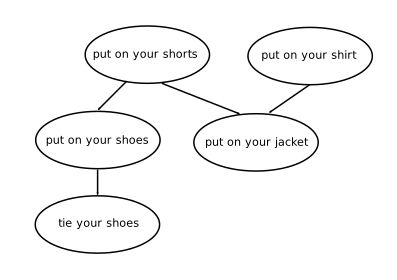
// First, we define our edges.
var graph = [
  ['put on your shoes', 'tie your shoes']
, ['put on your shirt', 'put on your jacket']
, ['put on your shorts', 'put on your jacket']
, ['put on your shorts', 'put on your shoes']
]


// Now, sort the vertices topologically, to reveal a legal execution order.
toposort(graph)
// [ 'put on your shirt'
// , 'put on your shorts'
// , 'put on your jacket'
// , 'put on your shoes'
// , 'tie your shoes' ]
(Note that there is no defined order for graph parts that are not connected -- you could also put on your jacket after having tied your shoes...)
Sorting dependencies
It is usually more convenient to specify dependencies instead of "sequences".
// This time, edges represent dependencies.
var graph = [
  ['tie your shoes', 'put on your shoes']
, ['put on your jacket', 'put on your shirt']
, ['put on your shoes', 'put on your shorts']
, ['put on your jacket', 'put on your shorts']
]

toposort(graph)
// [ 'tie your shoes'
// , 'put on your shoes'
// , 'put on your jacket'
// , 'put on your shirt'
// , 'put on your shorts' ]

// Now, reversing the list will reveal a legal execution order.
toposort(graph).reverse()
// [ 'put on your shorts'
// , 'put on your shirt'
// , 'put on your jacket'
// , 'put on your shoes'
// , 'tie your shoes' ]
API
toposort(edges)
- edges {Array} An array of directed edges describing a graph. An edge looks like this:
[node1, node2](vertices needn't be strings but can be of any type).
Returns: {Array} a list of vertices, sorted from "start" to "end"
Throws an error if there are any cycles in the graph.
toposort.array(nodes, edges)
- nodes {Array} An array of nodes
- edges {Array} An array of directed edges. You don't need to mention all
nodeshere.
This is a convenience method that allows you to define nodes that may or may not be connected to any other nodes. The ordering of unconnected nodes is not defined.
Returns: {Array} a list of vertices, sorted from "start" to "end"
Throws an error if there are any cycles in the graph.
Tests
Run the tests with node test.js.
Legal
MIT License